

Available Circular Economy Features
Missing Circular Economy Features
Pricing
Starting Price
Options
Available Since
Deployment Options
- Web Browser (Cloud - Based)
Good Option For
Deep dive
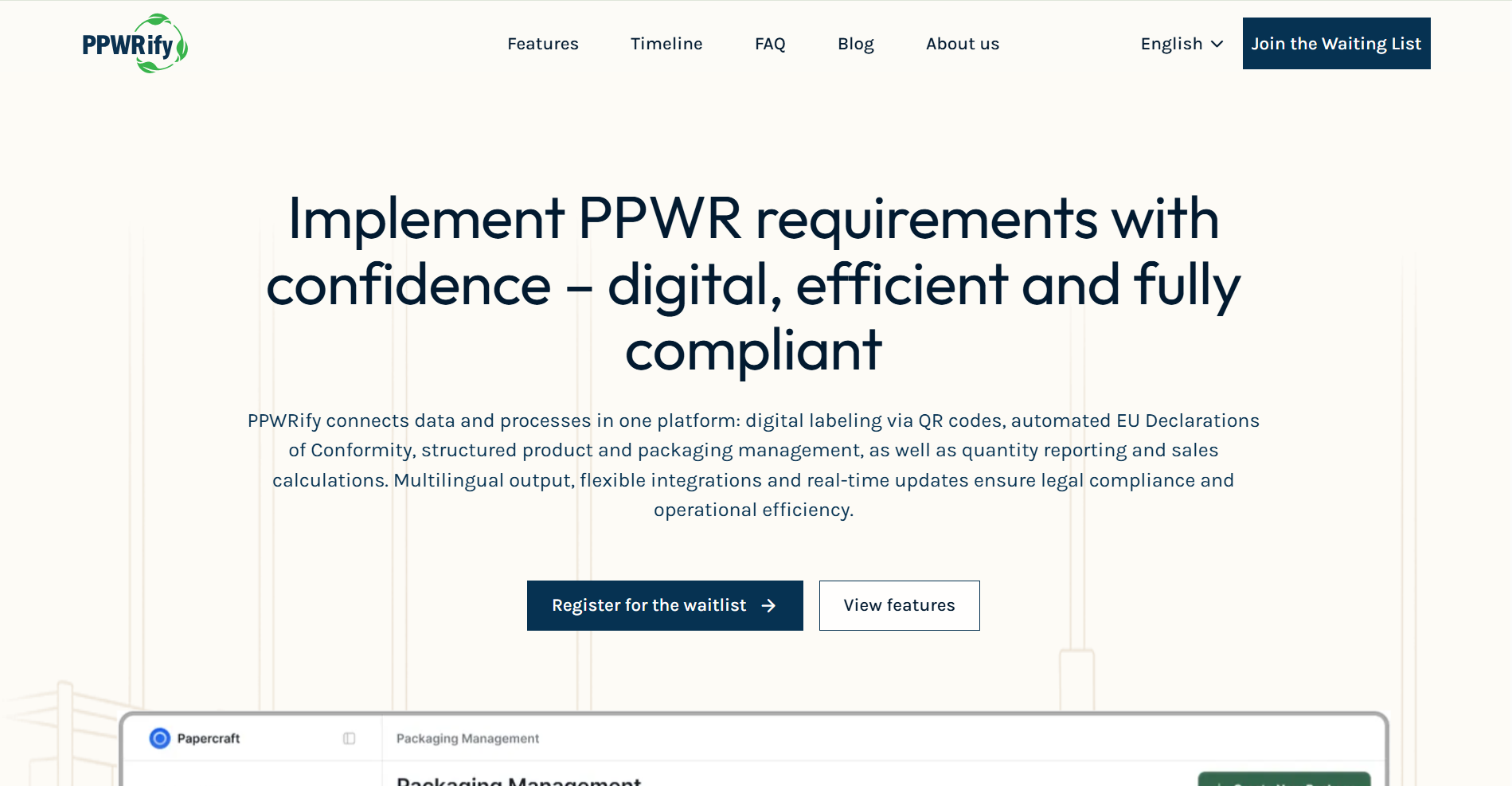
Core Features
1. Packaging Data Management
The platform provides a centralised repository for:
packaging materials and components.
product-level packaging data.
supplier information.
This enables consistent tracking and management across the organisation.
2. Regulatory Compliance (PPWR and Related Frameworks)
PPWRify supports:
evaluation of compliance with PPWR requirements.
alignment with EU packaging regulations.
preparation for evolving regulatory frameworks.
This reduces the complexity of navigating regulatory changes.
3. Material Composition and Recyclability Analysis
A key capability includes:
detailed analysis of packaging materials.
assessment of recyclability.
identification of non-compliant or high-impact materials.
This supports the transition toward circular economy principles.
4. Sustainability Strategy Support
Beyond compliance, the platform enables:
identification of opportunities for packaging reduction.
evaluation of alternative materials.
alignment with sustainability goals.
This positions PPWRify as both a compliance and decision-support tool.
5. Reporting and Audit Preparation
The platform provides:
structured reporting outputs.
documentation aligned with regulatory expectations.
audit-ready data.
This simplifies interactions with regulators and auditors.
6. Dashboards and Visualisation
PPWRify includes dashboards that:
display compliance status.
track key metrics.
visualise packaging data.
These dashboards support both operational teams and decision-makers.
7. Integration with Enterprise Systems
The platform integrates with:
ERP systems.
product lifecycle management tools.
supplier data sources.
This ensures scalability and consistency across large organizations.
Plans & Pricing
Pricing for PPWRify is not publicly disclosed. The platform appears to follow a customised SaaS pricing model, with costs determined by packaging portfolio size, data complexity, regulatory scope, and integration requirements.
Integration
PPWRify integrates with:
enterprise IT systems.
product and packaging databases.
supplier data inputs.
Integration is focused on data aggregation, structuring, and compliance workflows.
Certifications & Awards
PPWRify does not publicly list specific certifications or industry awards on its website. There is no explicit indication of formal recognitions, third-party certifications or award programmes associated with the platform.
However, the solution is clearly positioned to support compliance with key European regulatory frameworks, particularly:
the EU Packaging and Packaging Waste Regulation (PPWR).
broader circular economy and packaging sustainability requirements.
alignment with extended producer responsibility (EPR) schemes.
It is important to distinguish between software certification (not indicated) and regulatory alignment support (core function of the platform).
Expert Voices & Market Position
PPWRify operates in a highly specialized and emerging category: domain-specific sustainability compliance software.
Within your catalogue:
Climefy → carbon accounting.
Horizon ESG → ESG platform.
ABB → industrial EMS.
PPWRify → packaging compliance.
This reflects a broader trend: ESG → domain-specific regulatory platforms (packaging, supply chain, etc.).
Customers & Use Cases
PPWRify is particularly suited for:
consumer goods manufacturers.
retailers and distributors.
companies operating across EU markets.
organizations with complex packaging portfolios.
Typical use cases include:
managing packaging compliance across products.
preparing for PPWR requirements.
analyzing packaging sustainability.
generating regulatory reports.
optimizing packaging design.
Closing Insights
PPWRify represents a new generation of regulation-driven sustainability software, where:
compliance is embedded in digital systems.
data becomes the foundation of the sustainability strategy.
regulatory complexity drives software adoption.
Its strengths include:
deep alignment with EU packaging regulations.
strong data structuring and compliance logic.
support for circular economy strategies.
Its limitations include:
narrow functional scope (packaging only).
no energy or carbon management.
limited ESG coverage.
no operational integration.
It should be understood as a specialized regulatory data platform for packaging sustainability and compliance.