

Available Supply Chain Sustainability Features
Missing Supply Chain Sustainability Features
Pricing
Starting Price
Options
- Free
- Monthly Subscription
Available Since
Deployment Options
- Web Browser (Cloud - Based)
Good Option For
- Small Business (11-50 people)
- Medium Business (51-250 people)
- Large Business (250+ people)
Deep dive
Core Features
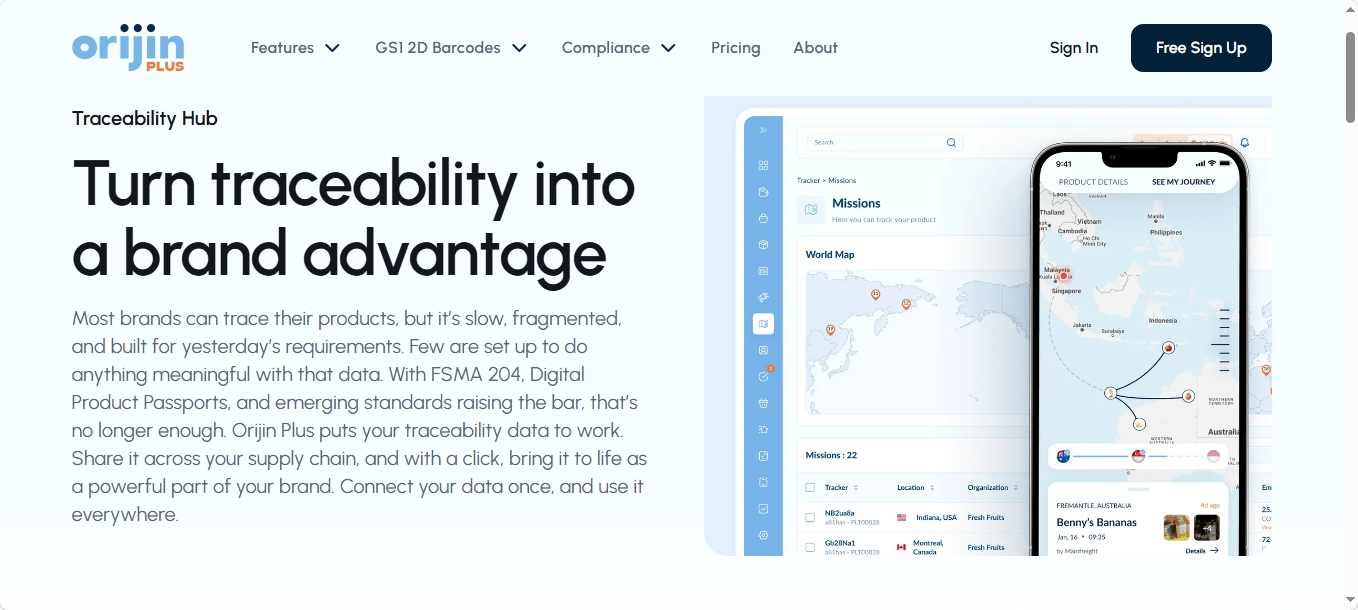
Orijin Plus provides a connected packaging infrastructure that combines QR-enabled product identities, GS1 standards, blockchain-supported traceability, and cloud-based product data management. Its key features include:
Digital Product Passport (DPP) Readiness — Supports structured product-data management aligned with emerging EU Digital Product Passport and ESPR-related transparency requirements.
Connected Packaging Infrastructure — Uses QR codes and GS1 Digital Link standards to connect physical products with dynamic digital content and traceability records.
Supply Chain Traceability — Enables brands to connect raw-material, manufacturing, and product-origin information into product-level digital records.
Blockchain-Based Provenance Verification — Incorporates blockchain technologies to support authenticity verification and tamper-resistant provenance records.
Certification & Sustainability Disclosure — Allows brands to present sustainability claims, certifications, sourcing details, and ethical-production information directly through packaging-linked interfaces.
Consumer Engagement & Loyalty Tools — Combines traceability functions with rewards programs, competitions, and digital engagement experiences tied to product packaging.
Closing Insights
Orijin Plus operates within the growing market for supply-chain transparency and Digital Product Passport infrastructure emerging around the EU Ecodesign for Sustainable Products Regulation (ESPR), GS1 Sunrise 2027 initiatives, and broader circular-economy requirements. Its positioning differs from traditional ESG or carbon-management platforms because it focuses primarily on product-level traceability, provenance, and connected-packaging workflows rather than emissions inventories or sustainability disclosure reporting.
The platform is particularly oriented toward consumer-facing industries where provenance and trust have commercial value alongside compliance needs. Company materials reference use cases involving food provenance, grass-fed and organic claims, carbon-neutral labeling, and certification visibility accessible through QR-linked packaging experiences.
A notable aspect of the platform is its alignment with GS1 Digital Link and DPP infrastructure trends rather than proprietary closed ecosystems. This may become increasingly relevant as industries prepare for phased DPP implementation across sectors such as textiles, electronics, furniture, and other regulated product categories. The company instead emphasizes configurable deployments, with materials stating that brands can connect “up to 50 features” to packaging-linked QR experiences depending on operational and consumer-engagement requirements.