

Available Carbon Accounting Features
Missing Carbon Accounting Features
Pricing
Starting Price
Options
Available Since
Deployment Options
- Web Browser (Cloud - Based)
Good Option For
Deep dive
Core Features
Carbon Footprint & Utilities Optimisation: GFP provides software to measure and monitor direct and indirect CO₂e emissions, including energy consumption and other operational data. The platform supports ongoing tracking of Scope 1, Scope 2, and selected Scope 3 emissions, giving companies a baseline for reduction strategies and progress monitoring.
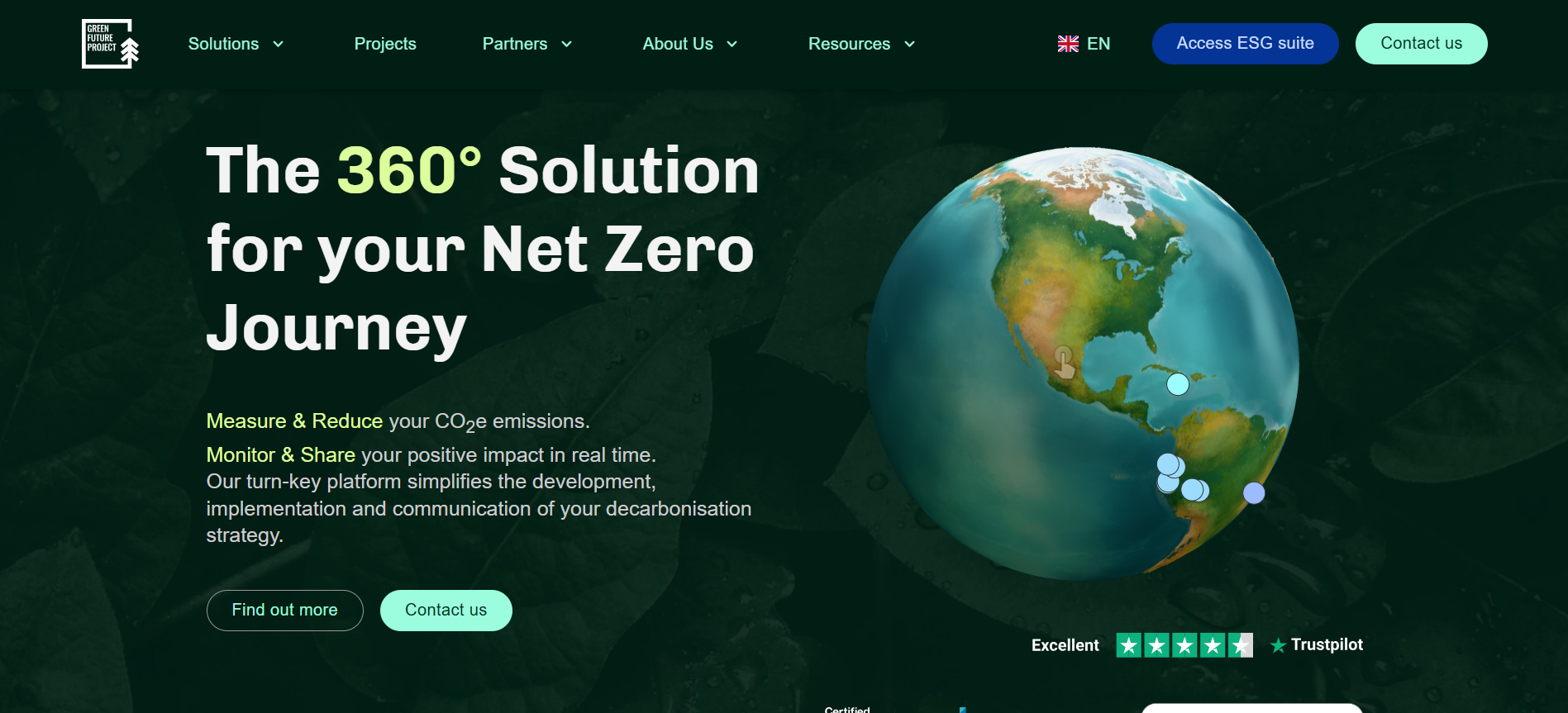
Real-Time Impact Dashboards: Organisations can customise impact dashboards that visualise emissions, reductions, and contributions to climate projects in real time. Dashboards can be branded and shared externally, helping communicate progress to customers, partners, and investors.
Climate Projects Marketplace: A core part of the platform is access to curated, certified climate projects. These include reforestation, forest and biodiversity protection, renewable energy, and marine restoration initiatives across several countries. Companies can purchase carbon credits and “biodiversity tokens” or activate recurring subscriptions for employees, enabling ongoing support for nature-based solutions.
ESG Advisory & Strategy: GFP offers ESG advisory services to help organisations define climate and sustainability strategies, align with regulatory developments such as the EU Corporate Sustainability Reporting Directive (CSRD), and integrate ESG into corporate decision-making. Advisory support complements the software, particularly for companies early in their sustainability journey.
ESG Academy & Employee Engagement: Through the ESG Academy (and HuPlay within the GFP Group), the company delivers digital and in-person training on sustainability topics, helping build internal literacy and engagement. Organisations can create customised courses and link training initiatives to their climate projects and impact dashboards.
Project Monitoring & Transparency: To enhance transparency of supported projects, GFP uses data and satellite imagery from partners such as Orbify to monitor reforestation and other on-the-ground activities. Companies can track project progress and impact indicators, strengthening the credibility of their climate claims.
Plans & Pricing
Public sources describe GFP as a flexible platform rather than a product with fixed public price tiers. The company appears to operate on a tailored pricing model based on:
Platform modules used (carbon footprint, utilities, impact dashboards)
Portfolio and volume of climate projects supported
Level of ESG advisory and training services
Size and complexity of the organisation
Third-party directories emphasise that GFP targets organisations seeking an integrated pathway covering measurement, reduction, and offsetting, which suggests pricing is negotiated on a case-by-case basis.
Integrations
GFP positions its platform as easy to integrate within existing business processes, but there is limited public detail on technical integrations, such as APIs or direct links to ERP or HR systems. Data for energy and emissions monitoring is typically imported from utility bills, internal records, and other corporate systems, with dashboards and reporting then generated in the GFP environment.
Certifications & Awards
Green Future Project is certified as a B Corporation, with a B Impact Score of 105, significantly above the B Corp qualification threshold of 80 and the median score for standard businesses. The certification recognises GFP’s governance, environmental management, and community impact.
The company is also described as an “innovative start-up” in Italy and is featured in several external articles and case studies highlighting its subscription model for climate projects and its role as a climate-tech platform.
Expert Voices & Reviews
Third-party software directories describe Green Future Project as a “strategic partner” for monitoring and reducing energy consumption and CO₂e emissions while enabling offsetting through project investments.
The B Corp profile emphasises the platform’s ability to monitor environmental impact in real time, track project progress through data and satellite imagery, and provide a complete and integrated solution for companies.
Case studies with clients such as POLIMI Graduate School of Management and other brands show the platform being used to measure institutional footprints, implement reduction plans, and communicate impact via public dashboards and impact cards.
Customers & Case Studies
Green Future Project works with a range of clients, including universities, consulting firms, consumer brands, and industrial companies. Examples cited publicly include:
POLIMI Graduate School of Management, using the carbon footprint software to measure emissions and plan its path to net zero, while investing in climate projects and offsetting part of its employees’ emissions.
JAKALA and other Italian companies, which use the platform to measure Scope 1, 2, and 3 emissions and support climate projects.
Various clients showcased via public impact dashboards and case-study articles, highlighting real-time impact visualisation and stakeholder engagement.
Closing Insights
Green Future Project occupies a hybrid position between carbon accounting software, climate-project marketplace, and ESG advisory. Its strengths lie in making climate action visible and engaging, especially for organisations that want to combine emissions measurement with concrete support for nature-based and renewable projects.
The platform is particularly suitable for companies seeking:
A unified view of energy use, emissions, and climate projects
Branded impact dashboards for communication and stakeholder engagement
ESG training and advisory combined with technology
A curated, transparent portfolio of projects, supported by satellite monitoring
However, GFP is not a pure-play enterprise carbon-accounting engine. Organisations with highly complex, audit-grade reporting needs (for example, detailed CSRD or SEC climate filings, granular Scope 3 category accounting, or advanced scenario analysis) may need to complement GFP with more specialised carbon accounting or data-management systems.
Overall, Green Future Project is a strong candidate for mid-sized and larger organisations that want a visible, engagement-oriented climate platform backed by credible projects and B Corp credentials, especially in European markets.