

Available Carbon Accounting Features
Missing Carbon Accounting Features
Pricing
Starting Price
Options
Available Since
Deployment Options
- Web Browser (Cloud - Based)
Good Option For
- Small Business (11-50 people)
- Medium Business (51-250 people)
- Large Business (250+ people)
Deep dive
Core Features
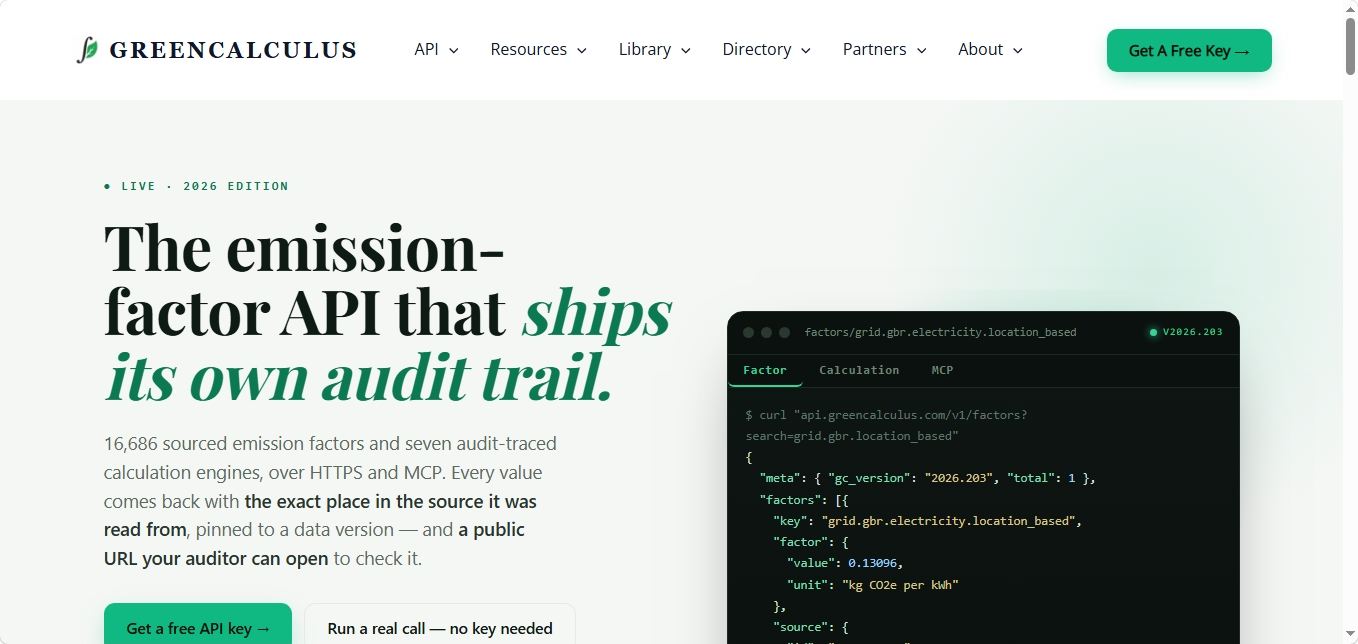
GreenCalculus focuses on a problem that can be easy to overlook in carbon accounting: the final emissions figure is only as defensible as the data and calculation behind it. A platform may calculate emissions correctly but still leave a user with considerable work if an auditor asks which spreadsheet, table or cell supplied a particular emission factor. GreenCalculus is designed to preserve that chain of evidence automatically.
Traceable Emission Factors: Its MasterBrain database contains 16,686 factors from sources including DEFRA, IPCC, EPA, GLEC, PCAF and other publishers. GreenCalculus records not merely the publisher but the precise source reference from which a value was obtained.
Reproducible Carbon Calculations: Results are pinned to a particular database version and returned with their calculation workings. This means a previously reported figure remains traceable even after the underlying publisher subsequently updates its factors.
Calculation Engines: Seven engines cover activity-based calculations, Scope 2 electricity, PCAF financed emissions, embodied carbon, freight, spend-based emissions and business travel. Batch processing supports up to 100 calculation line items in one request.
Carbon Data API: Developers can integrate the factor database and calculation engines directly into ESG software, procurement systems, internal applications or other digital products instead of building and continually maintaining their own emission-factor database.
AI-Ready Carbon Data: GreenCalculus provides an MCP server through which compatible AI agents can find factors and execute calculations. This gives an AI application access to structured carbon data with identifiable sources rather than requiring it to generate or recall emission factors itself.
Public Verification: Factor searches, methodologies and supporting information can be inspected publicly. API results can also include verification URLs, allowing another person—including an auditor—to examine the factor and version underlying a calculation.
Closing Insights
GreenCalculus is particularly useful when users need to look beyond the final emissions figure and verify the data behind it. A sustainability team, for example, may need to trace an emission factor to its original source during assurance or reproduce a calculation from an earlier reporting period. Consultants can use it when clients need calculations that can be independently checked, while software developers can integrate carbon calculations without building and maintaining their own emission-factor database. It also provides AI-based sustainability tools with sourced numerical data, reducing reliance on emission factors generated or recalled by the AI model itself. Established in Singapore in 2025 by Jeremiah Say, GreenCalculus has developed this proposition around its versioned MasterBrain data layer, which currently contains over 16,000 factors from 168 registered sources across 217 countries. Its MCP integration extends the same traceability model to AI applications.
GreenCalculus therefore need not replace an organization's existing carbon accounting software. Its practical value may instead be greatest where users need a stronger, independently checkable data layer beneath their existing calculations, reporting processes or software products. The company also cautions that its factors are published averages and may not reflect a user's specific operational circumstances, and that users requiring formally auditable accuracy should still verify data against primary sources within their documented inventory process.
Prospective users can explore GreenCalculus before committing to a paid plan: the full factor corpus can be browsed without an account, while the free API tier includes 1,000 calls per month and access to all calculation engines. For production use at greater scale, the Developer plan starts at US$49 per month for 50,000 calls. Business costs US$299 per month and adds 500,000 calls, bulk corpus access and redistribution rights, while Enterprise provides custom capacity and additional licensing options.