


Available Carbon Accounting Features
Missing Carbon Accounting Features
Pricing
Starting Price
Options
- Free Trial
Available Since
Deployment Options
- Web Browser (Cloud - Based)
Good Option For
- Small Business (11-50 people)
- Medium Business (51-250 people)
- Large Business (250+ people)
Deep dive
Cre Features
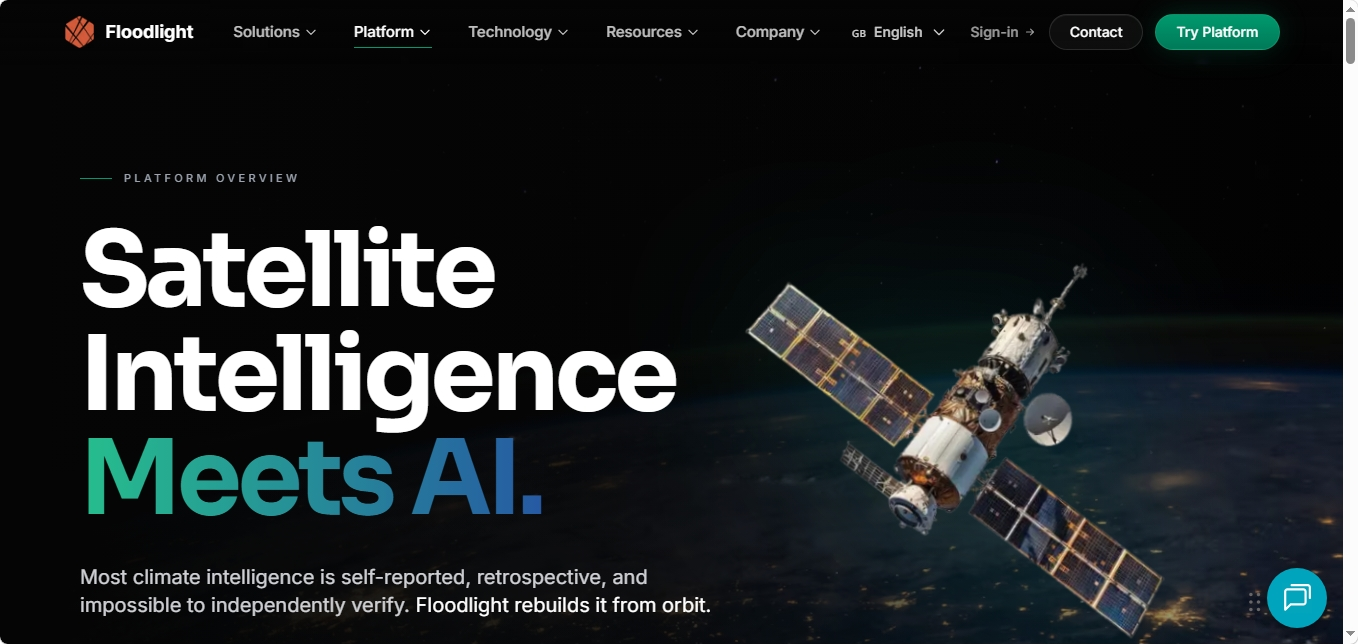
Floodlight combines several specialist products within a common climate intelligence platform. Its capabilities cover satellite-based emissions estimation, physical climate risk assessment, carbon removal monitoring and financial analysis, with dashboards and integration tools for different users.
Satellite-Based Emissions Monitoring (SAGE): Uses observations from NASA, ESA and JAXA satellite missions to estimate Scope 1 emissions at facility and city levels. Scope 2 emissions are estimated using building footprints and regional electricity intensity.
Physical Climate Risk Assessment (REST): Evaluates exposure to ten hazards, including flooding, wildfires, extreme temperatures, storms and drought. It calculates Expected Annual Loss, Climate Value at Risk and climate-adjusted property valuations for real estate portfolios.
Carbon Removal Monitoring (VAULT): Uses satellite imagery and biomass models to estimate carbon sequestration in forests, soils and geological storage projects. It supports monitoring of permanence, potential reversals and the evidence underlying carbon removal claims.
Climate Scenario and Financial Risk Analysis: Models the potential financial consequences of physical and transition risks under different climate pathways. Portfolio-level analysis helps investors and risk managers examine asset exposure, expected losses and valuation implications.
Emissions Verification and Audit Support: Compares satellite-derived emissions estimates with conventional inventories. Its methodology includes uncertainty estimates, data provenance records and quality assurance procedures, with outputs designed to support GHG Protocol and ISO 14064-aligned reporting.
Closing Insights
Founded in 2019 by Nate Wyne, Suchi Gopal and Josh Pitts, Floodlight was established to make satellite-derived environmental data accessible for business and financial decision-making. Its development brought together expertise in climate science, remote sensing, artificial intelligence and financial markets.
As climate disclosure requirements evolve, attention is increasingly turning to the credibility and independent verification of reported emissions. Conventional carbon accounting platforms remain essential for calculating corporate greenhouse gas inventories, but their reliance on activity data and emissions factors can leave gaps between estimated and actual emissions. Satellite observations and other measurement-based approaches provide an additional means of checking reported figures, particularly in emissions-intensive industries such as oil and gas, mining, steel and cement production.
Floodlight's approach is relevant to this growing emphasis on independently observed environmental data, complementing rather than replacing conventional carbon accounting.