

Available ESG Monitoring Features
Missing ESG Monitoring Features
Pricing
Starting Price
Options
Available Since
Deployment Options
- Web Browser (Cloud - Based)
Good Option For
- Small Business (11-50 people)
- Medium Business (51-250 people)
- Large Business (250+ people)
Deep dive
Core Features
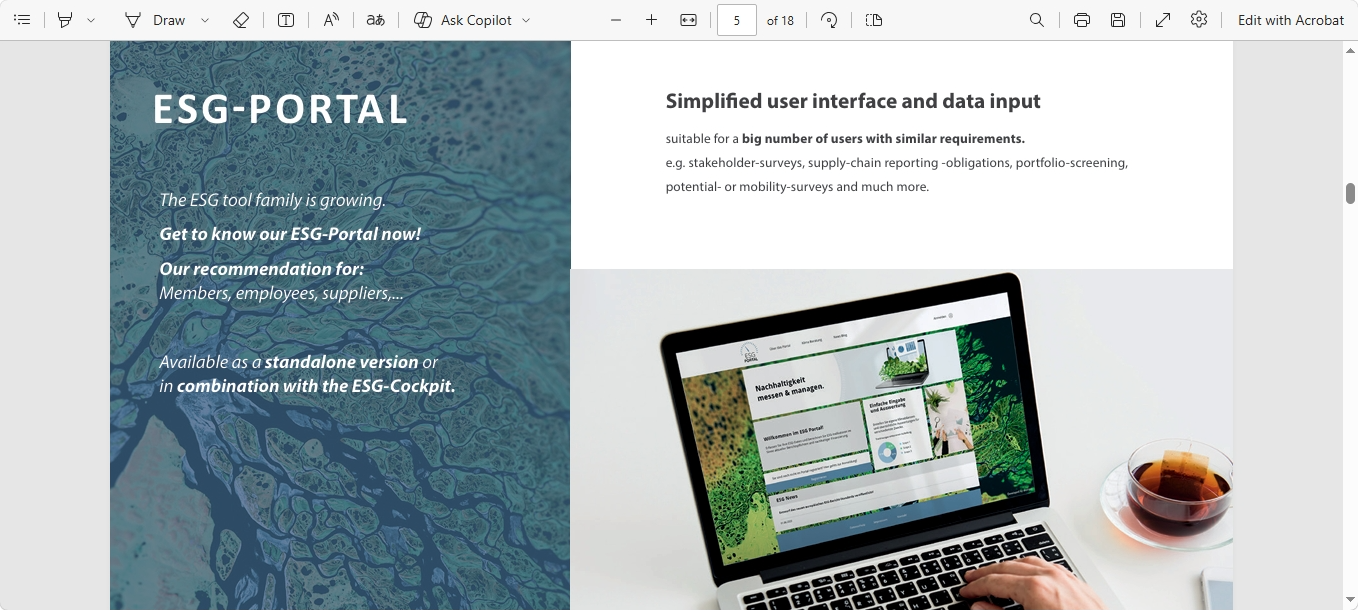
ESG-Portal is designed as a lightweight data collection layer that complements more comprehensive sustainability systems by enabling broad user participation. Its structure prioritises ease of use and scalability, allowing organisations to standardise inputs from large user groups across different contexts. Some of its main features include:
Simplified User Interface – Provides an accessible input environment designed for users without specialist ESG expertise.
Scalable Data Collection – Supports large numbers of users with similar input requirements, including employees, suppliers, and members.
Survey-Based Data Gathering – Enables stakeholder surveys, including mobility surveys and ESG-related questionnaires.
Supply Chain Reporting Inputs – Collects sustainability data from suppliers for reporting and compliance purposes.
Portfolio & Screening Applications – Supports portfolio-level data collection and screening exercises across organisations or networks.
Flexible Deployment (Standalone or Integrated) – Can operate independently or feed data into ESG Cockpit for further analysis and reporting.
Closing Insights
ESG-Portal is part of akaryon’s broader ESG software ecosystem, extending its tools beyond centralised sustainability management to include distributed data collection. While ESG Cockpit is used for calculation, analysis, and reporting, ESG-Portal focuses on capturing inputs from a wider group of contributors, including non-specialist users. This distinction reflects different operational needs: structured data management on one side, and scalable input collection on the other.
The platform has been applied in a range of contexts. Examples include a climate portal developed for the Austrian Economic Chambers, where member companies can create initial greenhouse gas balances and the “Goldener Boden” initiative, which supports municipalities in collecting and evaluating data related to regional economic and sustainability activities. These examples show how ESG-Portal can be adapted to different sectors, from business networks to public-sector programmes.
ESG-Portal expands the reach of sustainability systems by enabling structured data input at scale. It is suited to organisations that need to involve multiple stakeholders in ESG data collection processes without requiring them to use full-featured sustainability software.