


Available ESG Monitoring Features
Missing ESG Monitoring Features
Pricing
Starting Price
Options
Available Since
Deployment Options
- Web Browser (Cloud - Based)
Good Option For
- Small Business (11-50 people)
- Medium Business (51-250 people)
- Large Business (250+ people)
Deep dive
Core Features
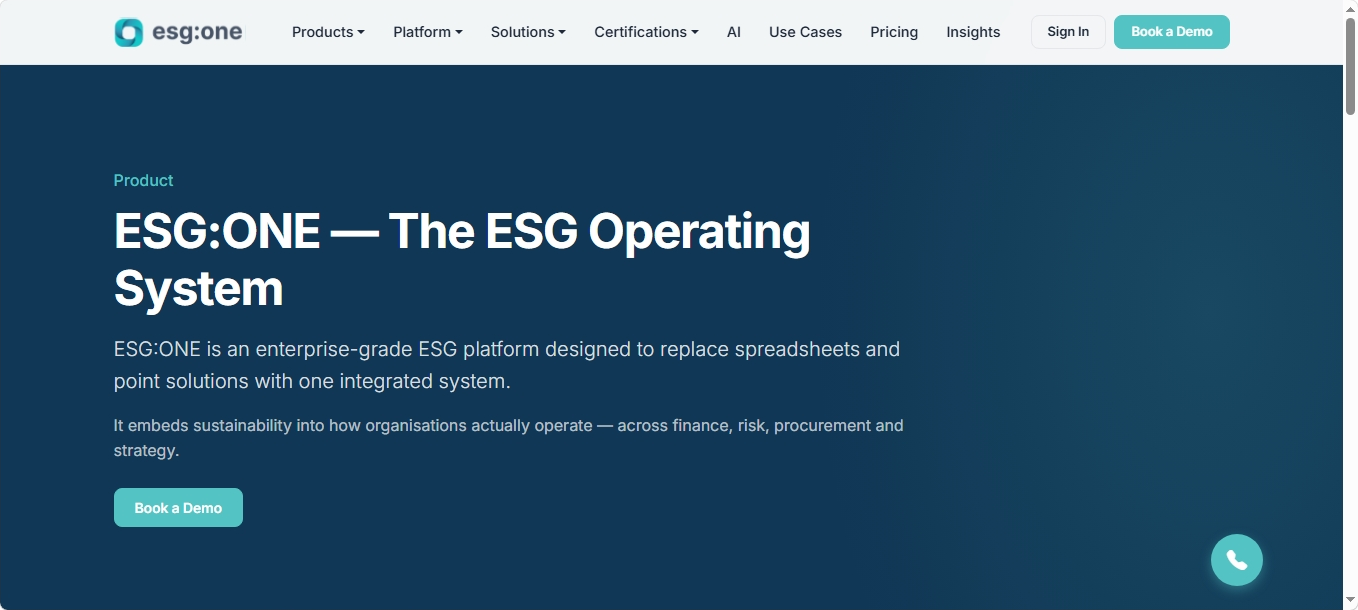
ESG:ONE is built to function as an integrated ESG operating system rather than a standalone reporting tool. its main capabilities include:
Integrated ESG Data Management — Centralizes ESG data from utility bills, supplier surveys, ERP systems, HR systems, and operational platforms into a governed data environment with audit trails and validation controls.
Carbon Accounting and Scope 3 Analysis — Supports Scope 1, 2, and 3 emissions calculations using activity-based and spend-based methodologies alongside emissions-factor libraries and supplier workflows.
Supplier ESG and LCA Workflows — Provides supplier engagement tools, ESG questionnaires, lifecycle-assessment support, and continuous supplier monitoring for supply-chain sustainability programs.
Climate Risk and Materiality Analysis — Includes physical and transition-risk analysis, facility-level exposure assessment, and double-materiality evaluation capabilities.
Enterprise System Integration — Connects with ERP, procurement, finance, HR, and operational systems through APIs and pre-built integrations intended to embed ESG processes into broader business operations.
Closing Insights
ESG:ONE’s functioning reflects a broader shift in the ESG software market away from standalone reporting tools toward integrated operational platforms. The company repeatedly frames ESG management as an enterprise data and governance problem rather than simply a disclosure exercise. As demonstrated in use cases, its “one platform” architecture is an attempt to consolidate workflows that many organizations currently manage across separate carbon-accounting, supplier-risk, reporting, and governance systems.
The company differentiates ESG:ONE from its separate QuantESG Analytics product by focusing here on ESG operations, governance, reporting, and workflow orchestration rather than direct ESG valuation and financial-impact modeling. ESG:ONE’s pricing structure includes Starter, Professional, and Enterprise tiers, scaling from basic Scope 1 and 2 reporting to broader Scope 3, supplier ESG, API integration, and enterprise governance functionality. The platform also promotes relatively rapid implementation timelines, claiming organizations can go live within three weeks.