


Available Carbon Accounting Features
Missing Carbon Accounting Features
Pricing
Starting Price
Options
- Free
- Annual Subscription
Available Since
Deployment Options
- Web Browser (Cloud - Based)
Good Option For
- Freelancers (1 person company)
- Microbusiness (2-10 people)
- Small Business (11-50 people)
- Medium Business (51-250 people)
- Large Business (250+ people)
Deep dive
Core Features
EPIQR is built around a formal methodology, where data collection, analysis, and reporting follow a structured and standardised process. Its environmental outputs—particularly indirect emissions—are derived directly from this methodological framework rather than standalone calculations. Its main features include:
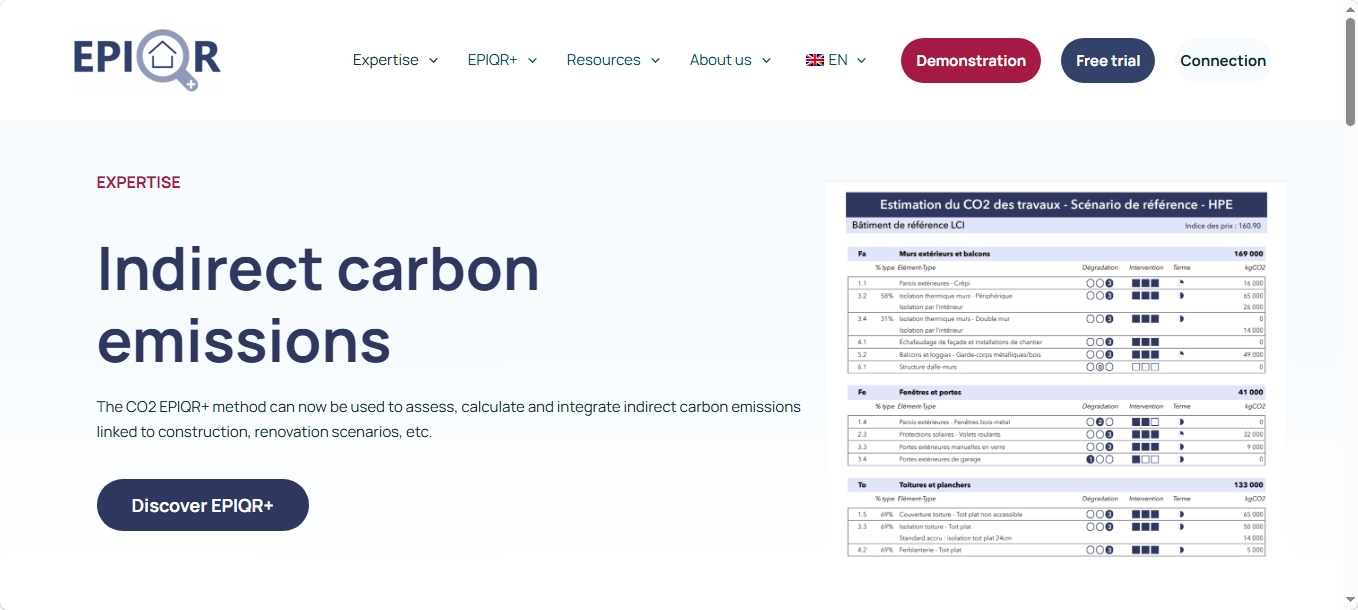
Indirect Carbon Emissions (EPIQR CO₂) – Calculates the embodied CO₂ associated with renovation works, including materials, replacements, and disposal phases, integrated directly into scenario outputs
Lifecycle-Based Carbon Reporting (SIA Framework) – Structures emissions calculations according to lifecycle assessment principles aligned with SIA 2032, covering all renovation elements and their associated material and energy flows
Component-Level Emissions Breakdown – Produces detailed reports of CO₂ emissions by building element and over time, enabling granular analysis of which interventions drive carbon impact
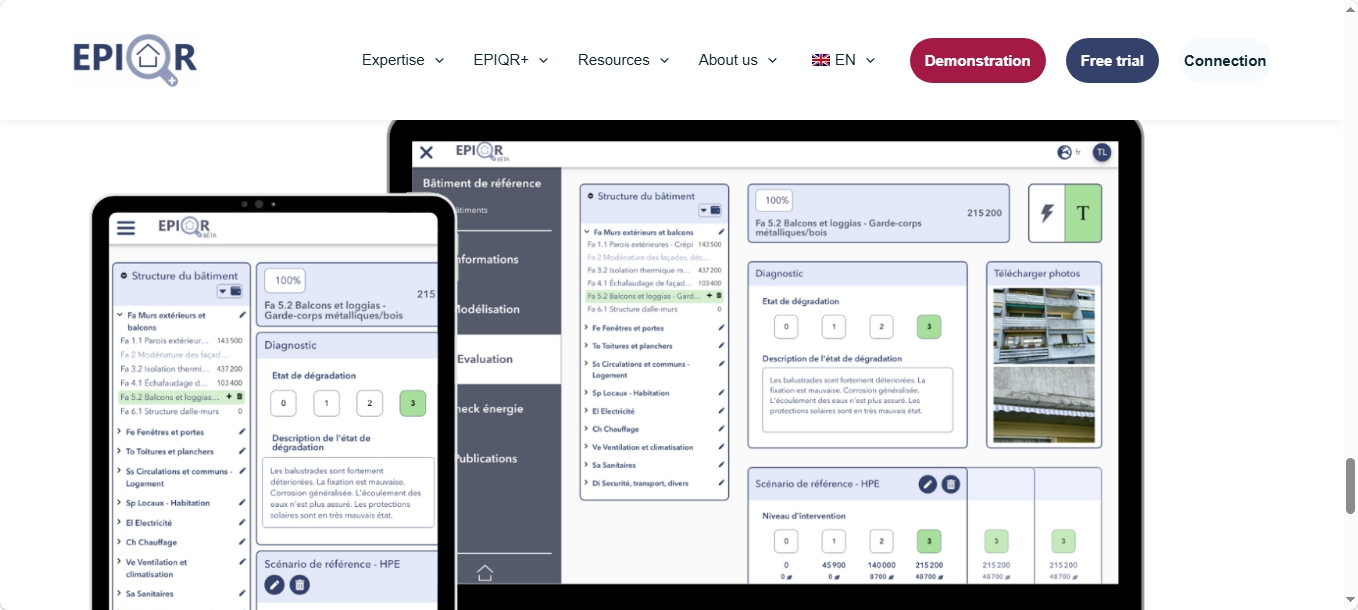
Scenario-Based Carbon Comparison – Allows users to compare renovation strategies not only on cost but also on CO₂ impact, helping optimise interventions against both financial and carbon constraints
Integrated Cost–Carbon Reporting – Calculates indirect emissions in parallel with renovation costs, enabling combined reporting without additional modelling steps
LCA Data Integration (Construction Databases) – Uses Swiss (KBOB) and European (Ecoinvent, INIES) datasets to ensure emissions calculations reflect recognised construction lifecycle data
Closing Insights
EPIQR developed from research into building diagnostics and investment planning but has evolved into a tool that directly addresses the growing importance of embodied carbon in the construction sector. Its core contribution lies in embedding indirect CO₂ calculations within renovation workflows, allowing users to quantify emissions associated with construction activities rather than focusing solely on operational energy. This reflects a broader shift in building sustainability, where materials, replacements, and construction processes represent an increasing share of total emissions.
The platform is used by engineers, property owners, and public authorities to support renovation planning where carbon considerations must be balanced with cost and technical feasibility. Its reporting capabilities enable users to produce structured environmental outputs tied directly to renovation scenarios, rather than standalone carbon inventories.
EPIQR is particularly suited to users operating in the Swiss market, where lifecycle-based carbon reporting is guided by SIA standards, notably SIA 2032 and targets under SIA 2030. Its alignment with these frameworks allows practitioners to generate emissions assessments consistent with national green building requirements, especially in projects where indirect emissions and lifecycle impacts must be explicitly documented.