


Available ESG Monitoring Features
Missing ESG Monitoring Features
Pricing
Starting Price
Options
Available Since
Deployment Options
- Web Browser (Cloud - Based)
Good Option For
- Small Business (11-50 people)
- Medium Business (51-250 people)
- Large Business (250+ people)
Deep dive
Core Features
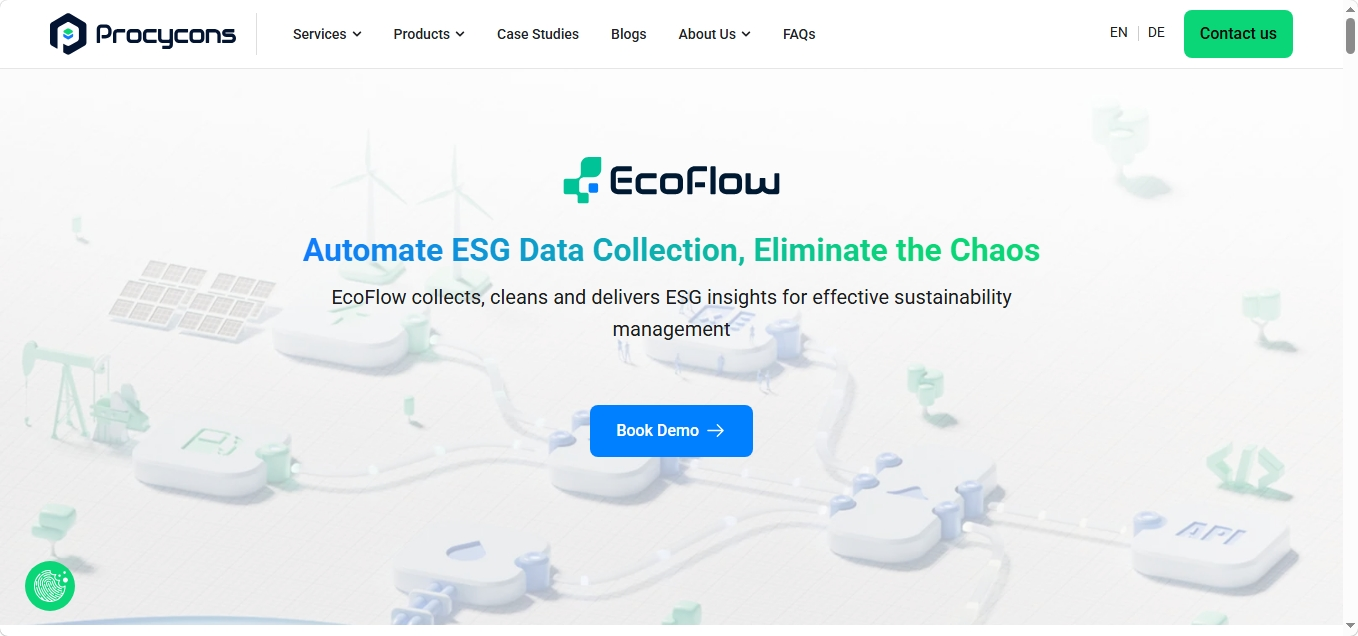
Procycons describes EcoFlow as filling the gap between raw ESG data sources and reporting platforms. Users can work with preconfigured flows or configure their own, while automation handles recurring collection and processing tasks.
Automated ESG Data Collection: EcoFlow collects information from APIs, email attachments, CSV, Excel and PDF files, IoT streams, and direct feeds from energy, fuel and logistics providers. Manual uploads are also supported.
AI-Powered Invoice Processing: Its Invoice Engine extracts structured sustainability information from invoices in real time, reducing the need to manually transfer consumption and other data from source documents.
Data Validation and Preparation: Incoming information is processed, checked and enriched before being transferred to reporting systems, helping address duplicates, gaps and inconsistent source data.
Configurable ESG Data Flows: Users can create custom flows or use preconfigured workflows for recurring ESG processes, such as transferring electricity, gas or fuel consumption from original sources into a sustainability system.
ESG Platform Integrations: Procycons identifies integrations with systems including SAP, Cority, Workiva and WeSustain. EcoFlow can also connect through APIs and other interfaces to existing enterprise and reporting infrastructure.
Closing Insights
EcoFlow reflects Procycons' broader combination of sustainability expertise and digitalization. The company works on carbon footprints, LCA and decarbonization strategies alongside AI and custom software development. This matters because EcoFlow addresses a less visible part of ESG management: the infrastructure required to move operational information reliably from its original sources into the systems where sustainability calculations and reporting take place.
Procycons has already applied this approach to a substantial data automation problem at KION Group. KION needed fuel-consumption information from its global vehicle fleet standardized, validated and transferred into its sustainability platform. Procycons developed an automated solution that it says reduced manual effort by 85% and achieved 99.5% data quality. Although the case study describes the underlying solution rather than explicitly identifying it as an EcoFlow deployment, it illustrates the type of ESG data problem EcoFlow is designed to solve.
EcoFlow's positioning is therefore somewhat different from general ESG reporting software. Organizations that already have a reporting platform may not need another system for dashboards and disclosure preparation; their bottleneck may instead be collecting reliable source data. EcoFlow is designed as that automation and integration layer. Procycons says implementations typically take 4–12 weeks, with initial automated flows potentially operational within days.