

Available DPP Features
Missing DPP Features
Pricing
Starting Price
Options
- Free
- Monthly Subscription
Available Since
Deployment Options
- Web Browser (Cloud - Based)
Good Option For
- Small Business (11-50 people)
- Medium Business (51-250 people)
- Large Business (250+ people)
Deep dive
Core Features
DPP Tool is built around a self-service, template-driven approach to Digital Product Passport creation, enabling users to structure product information in line with EU compliance requirements without extensive IT integration. Its core features include:
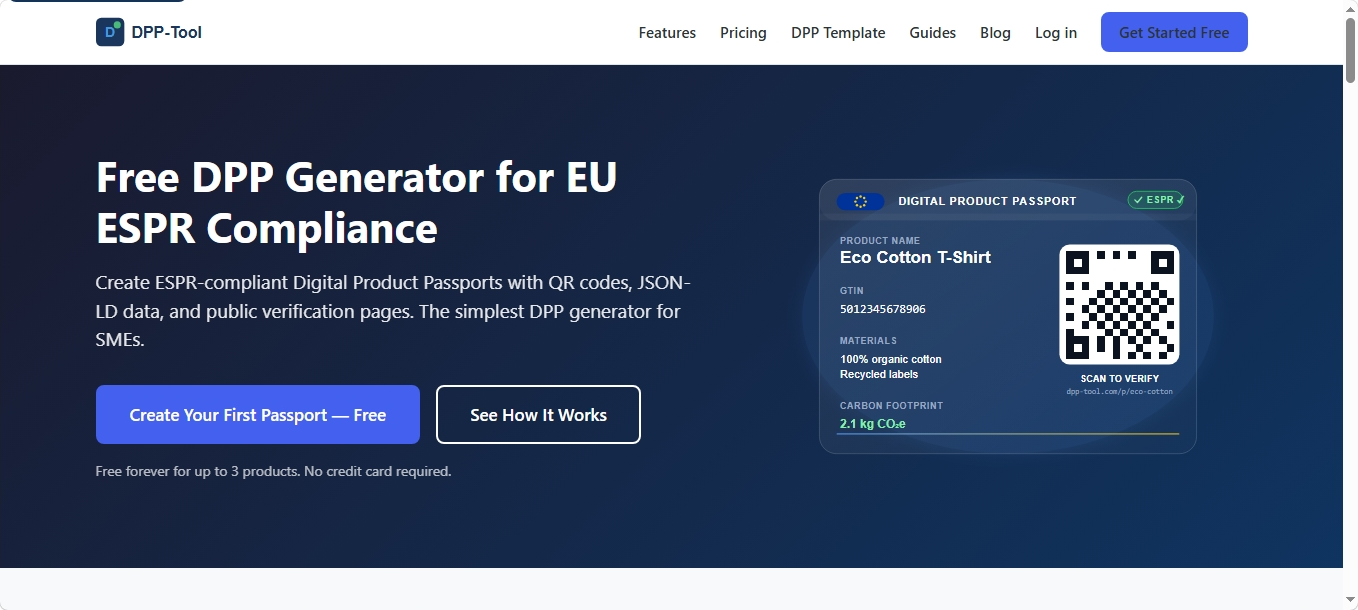
Digital Product Passport Creation: Generates ESPR-compliant passports that capture structured product data such as materials, carbon footprint, repairability, and compliance information, and publishes them as accessible digital records.
QR Code & GS1 Digital Link Integration: Creates GS1-compatible QR codes that link physical products to their digital passports, enabling regulators, consumers, and partners to access verified product data via a simple scan.
Structured Data & Interoperability (JSON-LD): Outputs machine-readable data formats to support interoperability across systems and alignment with EU digital infrastructure requirements for product transparency.
Bulk Import & Export (CSV/JSON/PDF): Allows users to upload large product datasets using CSV templates, with automated validation and error reporting, and export passport data for reporting or integration workflows.
API & System Integration: Provides REST API access for integrating passport generation into ERP, PIM, or e-commerce systems, supporting automated data flows and scalable implementation.
Multi-Sector & Multi-Product Coverage: Supports multiple ESPR-regulated product categories (e.g. textiles, electronics, batteries, construction products), enabling organisations to manage passports across diverse product portfolios.
Closing Insights
DPP Tool emerged in response to the growing need for accessible Digital Product Passport solutions as EU regulations such as ESPR move toward enforcement. The platform is presented as an alternative to enterprise-grade systems, which often require significant implementation resources and are typically designed for large organisations. By contrast, DPP Tool focuses on simplifying onboarding and reducing the technical and financial barriers associated with DPP adoption.
This approach reflects a broader market gap: many small and mid-sized companies need to comply with DPP requirements but lack the resources to deploy complex supply chain or lifecycle assessment systems. DPP Tool addresses this by offering a structured, template-based system that enables rapid passport creation and publication.
The platform’s pricing reinforces this positioning. It offers a free tier for up to three products, with paid plans starting at approximately €9–€29 per month and scaling to €99 per month for advanced features such as API access, batch processing, and multi-user support.