


Available Energy Management Features
Missing Energy Management Features
Pricing
Starting Price
Options
Available Since
Deployment Options
- Web Browser (Cloud - Based)
Good Option For
- Small Business (11-50 people)
- Medium Business (51-250 people)
- Large Business (250+ people)
Deep dive
Core Features
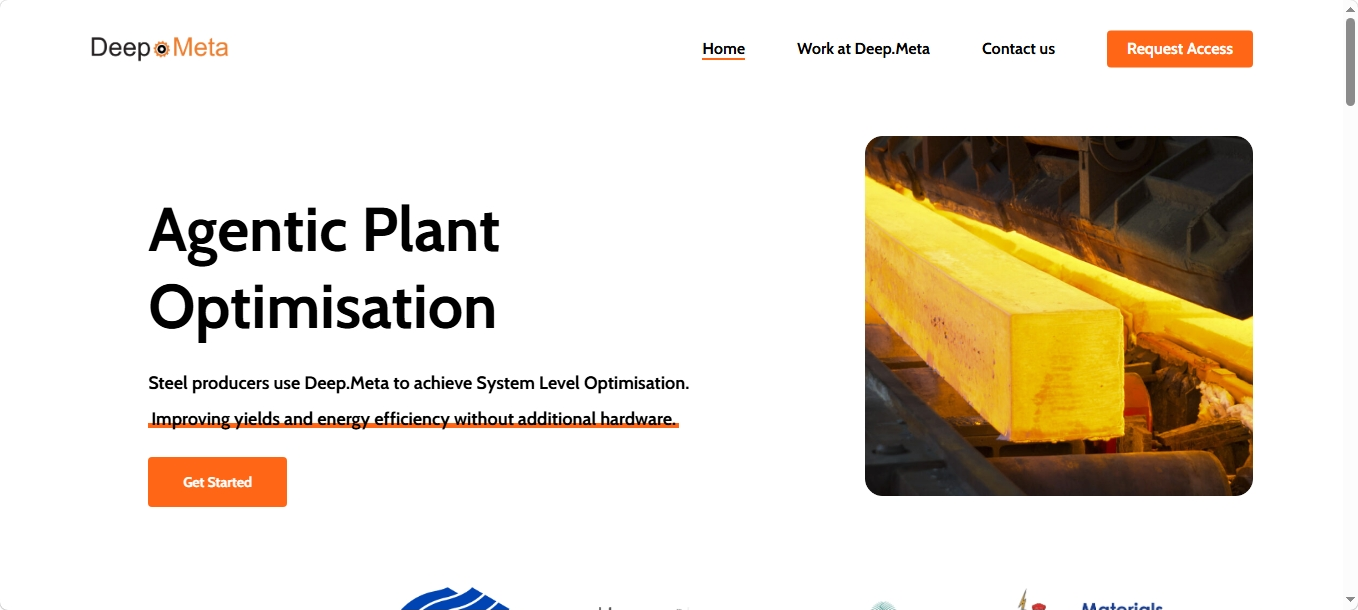
Deep.Meta applies artificial intelligence to production data already generated within steel plants. Rather than requiring extensive new instrumentation, the platform analyses operational data from across the melt shop, caster, reheating furnace, and rolling mill to identify opportunities for efficiency improvements and emissions reductions. Its core capabilities include:
Production Yield Optimisation – Identifies process improvements that reduce yield losses and increase steel output from existing inputs.
Energy Consumption Reduction – Analyses furnace and production data to minimise energy use during melting and reheating operations.
Real-Time Defect Prediction – Uses sensor data and machine-learning models to warn operators of potential quality issues before defects occur.
Digital Twin Technology – Creates AI-powered digital representations of steelmaking processes for optimisation and simulation.
Temperature Prediction & Scheduling – Predicts slab temperatures to improve furnace scheduling and process efficiency.
Carbon Emissions Reduction Analytics – Quantifies and supports operational changes that reduce emissions through lower energy consumption and improved process performance.
Closing Insights
Deep.Meta was founded in 2020 by Dr Osas Omoigiade and Aizar Enciso-Dominguez. Omoigiade's background combines sustainability, manufacturing, and a PhD in steel metallurgy, while the company's broader team brings together expertise in metallurgy, AI, machine learning, and industrial operations. This combination helps explain why the platform focuses on process optimisation rather than standalone sustainability reporting.
The company's flagship product, Deep.Optimiser, was developed to address a specific industrial challenge: reducing the environmental impact of steelmaking while maintaining productivity and profitability. Deep.Meta positions its technology as infrastructure for operational decision-making, using existing plant data to identify opportunities that might otherwise remain hidden within complex manufacturing processes. The company is also a member of ResponsibleSteel, the international multi-stakeholder initiative that develops standards and certification frameworks for responsible steel production.
For prospective users, Deep.Meta is best viewed as an industrial optimisation platform rather than a conventional ESG-reporting tool. Its value proposition lies in helping steelmakers improve operational efficiency and reduce emissions simultaneously. The company does not publish standard subscription pricing, instead offering commercial engagements tailored to individual industrial deployments and plant requirements.