

Available Carbon Accounting Features
Missing Carbon Accounting Features
Pricing
Starting Price
Options
Available Since
Deployment Options
- Web Browser (Cloud - Based)
Good Option For
- Small Business (11-50 people)
- Medium Business (51-250 people)
- Large Business (250+ people)
Deep dive
Core Features
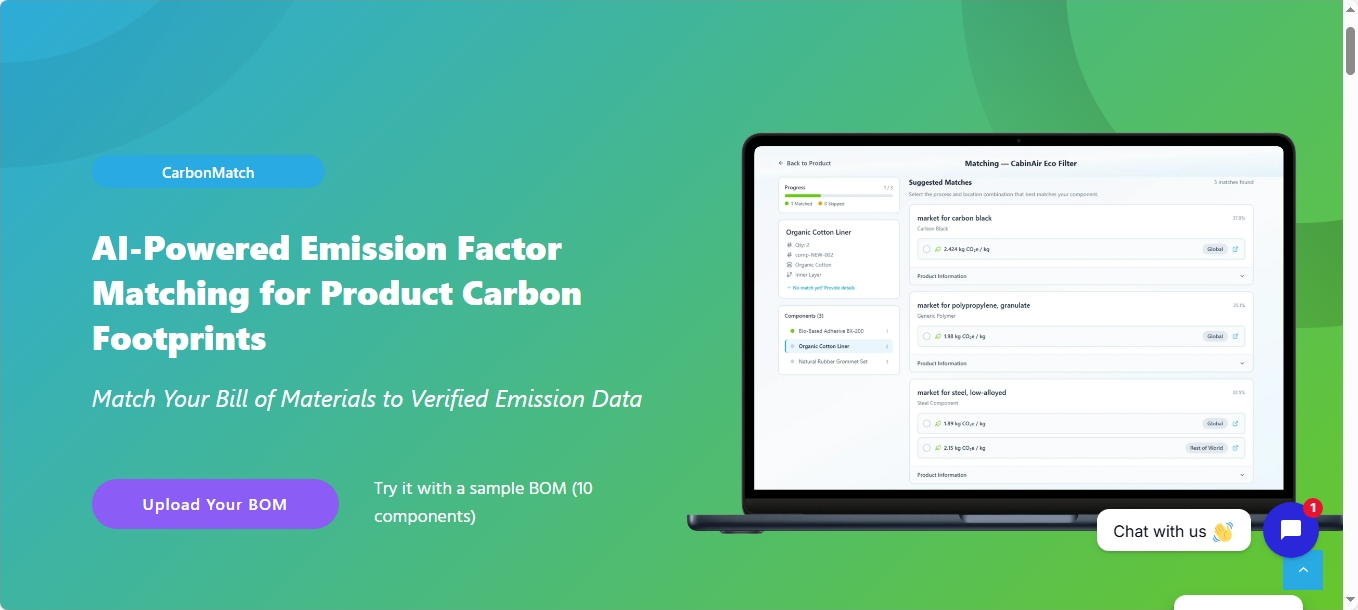
CarbonMatch takes a workflow-first approach to PCF data enrichment. Rather than calculating emissions directly, it focuses on contextualizing and standardizing component data from a bill of materials so that each item can be matched to verified environmental datasets. Its methodology blends semantic AI interpretation with structured datasets to support scalable, repeatable footprint work. Some of its main features are:
BOM Upload & Parsing: Users upload an XLSX bill of materials, and CarbonMatch extracts component identifiers, names, and material descriptors for processing.
AI Context Enrichment: The system uses automated web research (e.g., datasheets and specs) to syntactically and semantically enrich component descriptions before matching.
Semantic Dataset Matching: CarbonMatch performs similarity searches against trusted LCA databases like ecoinvent and returns ranked potential matches per component.
Confidence & Transparency Scores: Each match is accompanied by scores that help users evaluate quality and make consistent decisions.
Reusable Component Library: Once a match is confirmed, it is stored and reused for future BOMs, reducing repeated manual work.
Auditability Tools: Dataset detail panels and direct links to source records support traceability and documentation for PCF reporting.
Closing Insights
CarbonMatch emerged from CircularTree’s broader mission to standardize product carbon footprinting and supply-chain transparency. Its purpose reflects a specific operational gap: while many organisations can calculate PCFs with primary supplier data, the lack of standardized, reliable environmental data for all components impedes consistent, audit-ready results across large product portfolios. CarbonMatch’s use of semantic AI and dataset matching helps teams move from ad hoc searches to systematic, repeatable processes.
CarbonMatch differs from typical carbon accounting modules by specializing exclusively in environmental data alignment rather than full emissions calculation or supplier engagement. It’s particularly useful for sectors with complex multi-material assemblies, such as automotive, consumer electronics, and textiles, where sourcing high-quality primary data is often incomplete. Early use cases and partner profiles suggest that manufacturers integrating BOM data with ecoinvent and similar datasets can reduce manual matching time substantially and improve comparability of PCFs across product lines.
The platform generally operates on a quote-based subscription model tailored to organisational scale and dataset access needs. CarbonMatch typically integrates with enterprise workflows and can feed into broader PCF and supply-chain systems, positioning it as a complementary tool for teams already invested in lifecycle or footprint analytics.