


Available DPP Features
Missing DPP Features
Pricing
Starting Price
Options
Available Since
Deployment Options
- Web Browser (Cloud - Based)
Good Option For
- Medium Business (51-250 people)
- Large Business (250+ people)
Deep dive
Core Features
Digital Product Passport Creation
Circuland creates, manages, and shares Digital Product Passports across regulated industries. The platform is explicitly built for DPP use cases and supports passport outputs via web, PDF, and QR codes.
Product Data Integration
The platform connects to ERP, PIM, PLM, BIM, Microsoft 365 and document systems. It also offers open APIs to push and pull product data.
This makes Circuland strong for manufacturers and construction product companies that need to connect existing data sources into DPP records.
Unique Product Identification
Circuland supports unique identifiers such as GS1 and data carriers including QR, NFC, and RFID. This enables physical products or materials to connect to digital records.
Structured DPP Data Model
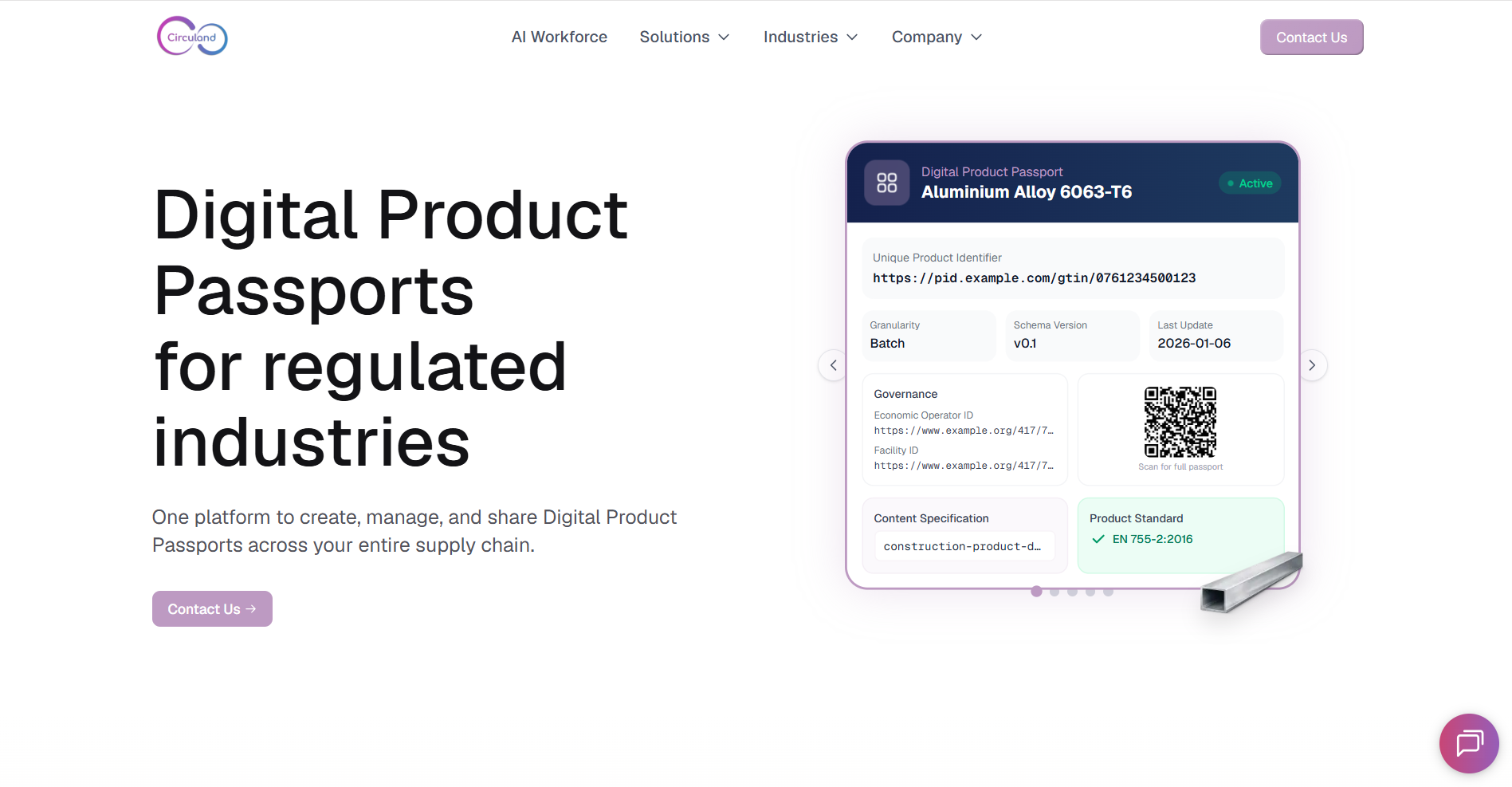
The platform shows structured passport fields such as unique product identifier, granularity, schema version, last update, governance, economic operator ID, facility ID, content specification, and product standard.
This indicates a structured and standards-oriented DPP data model.
Supply Chain Traceability
Circuland supports end-to-end supply chain traceability. This is a central capability for product origin, facility data, supplier data, and lifecycle transparency.
Product and Asset Lifecycle Management
The platform supports product and asset lifecycle management and dynamic updates as product data evolves.
This makes it relevant to lifecycle data updates and circular economy workflows.
Carbon and Circularity Dashboards
Circuland provides carbon and circularity dashboards. It also states that it calculates product carbon footprint using EN 15804 A1-D modules, sourced from EPDs, industry databases and supplier information.
This should be described as product-level carbon and circularity metrics, not corporate carbon accounting.
Optimization Opportunity Analysis
The platform includes optimization opportunity analysis for performance, reuse and impact.
This gives Circuland relevance to resource tracking, circularity improvement and performance optimisation.
Compliance Reporting
Circuland supports regulation-ready reports, full audit trails and compliance status tracking over time across products and markets.
Web, PDF and QR Passport Outputs
The platform can generate passport outputs via web, PDF and QR codes.
This supports both digital access and documentation workflows.
AI-Supported Workflows
Circuland references AI agents supporting DPP management and related workflows. It also offers AI-powered document management for classification and Golden Thread compliance.
Battery Passport Support
Circuland has a dedicated Battery Passport solution intended to meet EU Battery Regulation requirements.
Building Passport Support
Circuland provides Building Passports for end-to-end traceability in construction projects. This makes the platform relevant to construction lifecycle data, material transparency and building circularity.
Document Management
The company offers document management with AI-powered classification and Golden Thread compliance. This is particularly relevant for construction, product compliance evidence, and audit workflows.
Plans & Pricing
Pricing is not publicly disclosed. Circuland appears to follow a custom SaaS or enterprise pricing model, likely based on the number of product passports, product categories, data volumes, integrations, Battery Passport or Building Passport scope, carbon and circularity dashboard requirements, AI document management needs, users, markets and implementation support.
Integrations
Circuland integrates with ERP, PIM, PLM, BIM, Microsoft 365 and document systems through open APIs, webhooks, spreadsheet/bulk uploads and pre-built integrations including Akeneo, Pimcore and SAP. It also supports unique identifiers such as GS1 and data carriers including QR, NFC and RFID.
Certifications & Awards
Circuland publicly references recognition including the FIS Digital Innovation Award, Digital Construction Awards 2025 shortlist, Building Innovation Awards shortlist and Cemex Ventures Top 50 ConTech Green Construction category listing. These recognitions relate to innovation, construction technology and circularity work, not product-level environmental certification or third-party sustainability assurance. No specific ISO or SOC 2 certification is clearly disclosed on the reviewed DPP page.
Expert Voices & Market Position
Circuland occupies a strong and differentiated position in the Digital Product Passport software market because it combines DPP creation with supply chain traceability, construction lifecycle data, Battery Passports, Building Passports, carbon/circularity dashboards and AI-powered document workflows.
Compared with adjacent platforms:
Arianee is stronger for open protocol product identity, lifecycle ownership and connected customer engagement.
Kezzler is stronger for connected product serialization, smart packaging and enterprise product identity.
PSQR is stronger for EPCIS-based supply chain event data and regulated traceability infrastructure.
Qliktag is stronger for NFC, GS1 Digital Link, product digital twins and multi-carrier DPP deployment.
dpp.cloud is stronger for QR product pages, PIM/ERP integration and aftermarket service workflows.
NavelCord is stronger for controlled DPP publication and Battery Passport readiness.
Circuland is strongest where DPP implementation requires carbon/circularity dashboards, construction or manufacturing lifecycle data, Battery Passports, Building Passports and AI-supported document management.
Circuland should be positioned as:
Digital Product Passport Software.
Supply Chain Traceability Software.
Product Compliance Software.
Circular Economy Software.
Battery Passport Software.
Building Passport Software.
Product Sustainability Software.
Document Management Software.
The most important editorial nuance is carbon positioning. Circuland has stronger product-level carbon functionality than many DPP providers, including EN 15804-based product carbon footprint calculations. However, it should be listed as product carbon footprint and circularity metrics support, not as general corporate carbon accounting software.
Customers & Use Cases
Circuland is designed for regulated industries that need Digital Product Passports, supply chain traceability and lifecycle product data.
Typical customers include:
Construction product manufacturers.
Building product suppliers.
Battery manufacturers.
Tyre manufacturers.
Furniture manufacturers.
Fashion and textile companies.
Metal producers.
Iron, steel and aluminium companies.
Manufacturing companies.
Product compliance teams.
Sustainability teams.
Supply chain teams.
Circular economy teams.
Companies preparing for EU DPP requirements.
Companies preparing for EU Battery Regulation requirements.
Companies managing building or product lifecycle documentation.
Typical use cases include:
Creating Digital Product Passports.
Creating Battery Passports.
Creating Building Passports.
Connecting product data from ERP, PIM, PLM and BIM systems.
Managing product lifecycle data.
Supporting end-to-end supply chain traceability.
Updating product data dynamically.
Generating passport outputs via web, PDF and QR codes.
Tracking compliance status across products and markets.
Managing audit trails.
Calculating product carbon footprints using EN 15804.
Building carbon and circularity dashboards.
Identifying optimisation opportunities for performance, reuse and impact.
Supporting document classification and Golden Thread compliance.
Tracking materials from source to end-of-life.
Supporting circular resale, buy-back and service-based models.
Preparing product data for regulated categories such as batteries, construction, tyres, furniture and textiles.
Closing Insights
Circuland Digital Product Passport Software should be understood as a product lifecycle data platform for regulated industries preparing for DPP requirements. Its value lies in connecting product data from existing systems, structuring that data into passport-ready formats, maintaining traceability, tracking compliance status, and generating carbon and circularity insights.
The platform is particularly strong for construction and manufacturing contexts because it combines DPPs with Building Passports, Battery Passports, material tracking, document management and carbon/circularity dashboards. This gives Circuland a broader circular economy infrastructure profile than DPP tools focused mainly on consumer-facing product pages.