


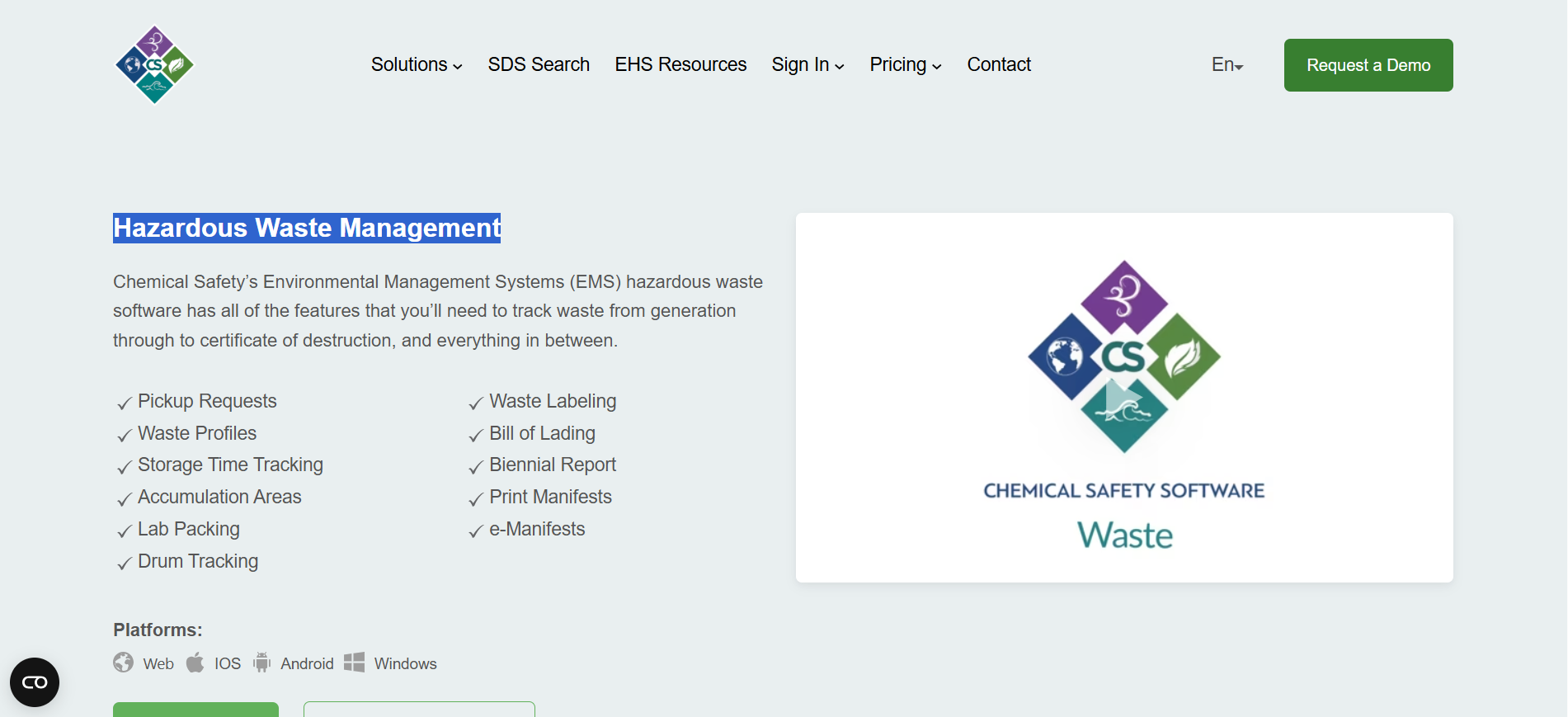
Available Waste Management Features
Missing Waste Management Features
Pricing
Starting Price
Options
Available Since
Deployment Options
- Web Browser (Cloud - Based)
Good Option For
Deep dive
Core Features
Hazardous Waste Tracking: Monitoring of hazardous waste containers from generation to disposal.
Waste Categorization: Classification using regulatory codes (e.g., hazardous classifications).
Inventory Management: Real-time tracking of waste container inventory and storage locations.
Regulatory Manifest Generation: Creation of legally required documentation for transport and disposal.
Compliance Reporting: Reporting aligned with hazardous waste regulations.
Multi-Site Support: Management of hazardous waste across multiple facilities.
Workflow Automation: Automated approvals, disposal scheduling, and documentation workflows.
Plans & Pricing
Chemical Safety operates under:
Subscription-based licensing.
Enterprise contracts.
Multi-site deployment pricing.
Pricing typically depends on:
Number of facilities.
Volume of hazardous waste tracking.
Regulatory complexity.
Integration scope.
Public pricing tiers are not disclosed.
Integrations
The software integrates with:
Laboratory Information Management Systems (LIMS).
Chemical inventory systems.
ERP systems (contextual integration).
Environmental health & safety (EHS) platforms.
It is not IoT-sensor dependent as a core feature.
Certifications & Assurance
The platform supports compliance with hazardous waste regulations, but is not:
A carbon verification authority.
An ESG assurance body.
Its regulatory alignment is strongest in hazardous materials governance.
Expert Voices & Market Positioning
Chemical Safety is positioned in the Environmental Health & Safety (EHS) and hazardous materials compliance segment.
Market positioning highlights:
Strong regulatory alignment.
Laboratory and academic sector focus.
Container-level hazardous waste tracking.
Compliance documentation automation.
From a Net Zero Compare perspective:
The platform supports environmental governance.
It does not function as a climate, carbon, or ESG reporting engine.
Sustainability relevance is compliance-based and risk-focused.
Customers & Use Cases
Typical customers include:
Academic research institutions.
Healthcare systems.
Pharmaceutical manufacturers.
Chemical production facilities.
Industrial laboratories.
Use cases include:
Hazardous waste container tracking.
Manifest documentation generation.
Audit preparation.
Regulatory compliance management.
Risk mitigation.
Closing Insights
Chemical Safety’s Hazardous Waste Management Software should be positioned as a Regulatory Hazardous Waste Compliance Platform. Its primary value lies in ensuring safe handling, documentation, and regulatory compliance for hazardous waste streams. It should not be classified as a carbon accounting, ESG monitoring, or climate analytics platform. Its environmental relevance is governance-driven rather than emissions-focused.