


Available Carbon Accounting Features
Missing Carbon Accounting Features
Pricing
Starting Price
Options
Available Since
Deployment Options
- Web Browser (Cloud - Based)
Good Option For
- Small Business (11-50 people)
- Medium Business (51-250 people)
- Large Business (250+ people)
Deep dive
Core Features
Carbonfact automates data ingestion from real product and supply-chain records, models cradle-to-grave impacts with an ISO-aligned method, and provides decisions at SKU, material and facility levels. Its main capabilities include:
Full-scope accounting: Corporate GHG accounting across Scopes 1, 2 and 3 with fashion-specific treatment of purchased goods (3.1) and facility, travel and logistics inputs.
SKU-level LCAs: Granular, cradle-to-grave product footprints with drill-downs by stage, component, material and emission factor; ISO 14040/44 method reviewed by PwC.
Scenario modeling: Product-level “what-if” simulations and catalog-wide reduction modeling to test material, supplier, transport and energy changes.
Compliance & disclosure: Built-outs for CSRD/ESRS, CDP, SBTi support, French Eco-score and PEF-aligned DPP exports.
Data integrations: Daily exports and API access to BigQuery, Snowflake, Redshift and Azure to feed BI stacks and DPP systems.
Governance & auditability: Version control for methods and factors, SOC 2 Type II, role-based access and EU data hosting.
Closing Insights
Carbonfact was founded by Marc Laurent, Martin Daniel and Romain Champourlier—leaders with backgrounds in data science and product engineering (Airbnb, JobTeaser) and experience mobilizing large data communities—who set out to replace spreadsheet-heavy workflows with automated, apparel-specific accounting and LCAs. The company is a Y Combinator alumnus and has since grown into an environmental data platform used by hundreds of brands and suppliers. In 2024, Carbonfact raised $15 million in Series A funding.
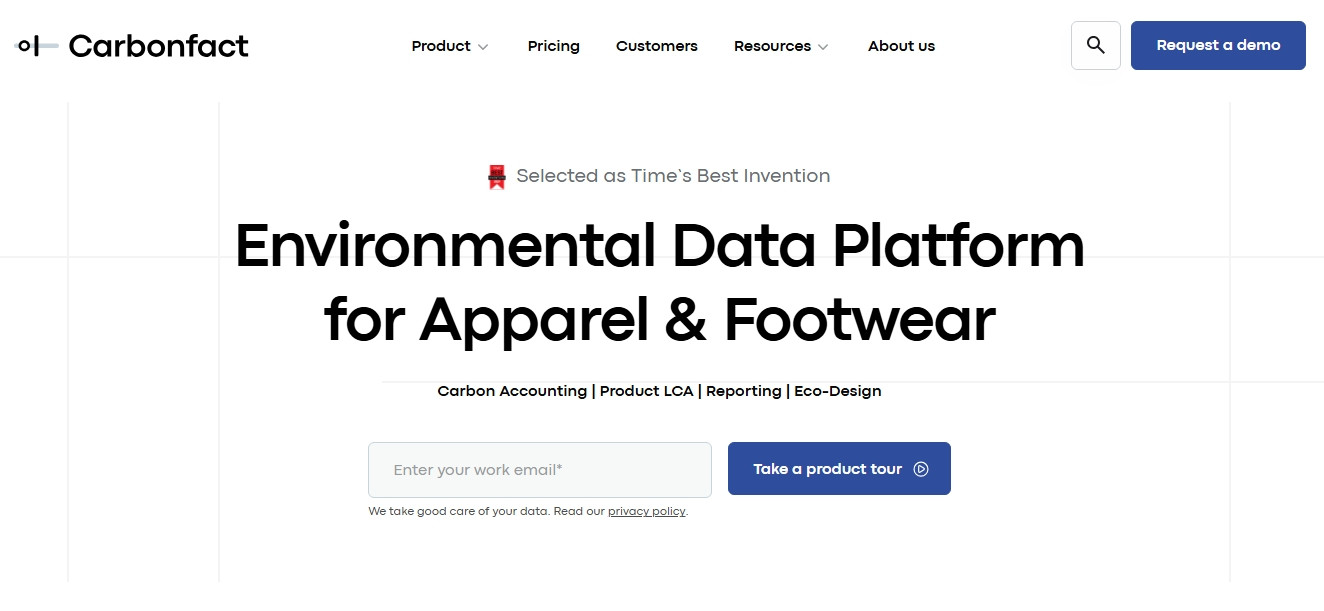
Its distinguishing factor is precision where fashion teams need it most: SKU-level, cradle-to-grave modeling with methods independently reviewed by PwC for ISO 14040/44, aligned to EU PEFCR drafts for apparel/footwear, and wired to real production data. That technical focus translates into recognizable outcomes with, for example, Adore Me reporting a 12% footprint reduction for a collection through Carbonfact’s product simulator. Recognition has also come with TIME naming Carbonfact one of the Best Inventions of 2024, highlighting its potential to make carbon tracking routine for fashion. Recent product momentum includes Digital Product Passports for EU readiness and expanded disclosure support for CSRD/CDP.
For teams comparing options, Carbonfact merits consideration if you want to connect product creation and regulatory reporting in one stack. Pricing is modular (no public list prices): brands can start with Carbon Accounting or Product LCA and add Reporting and Decarbonization services. Total cost depends on catalog size, data/IT complexity and service depth.