

Available Energy Management Features
Missing Energy Management Features
Pricing
Starting Price
Options
Available Since
Deployment Options
- Web Browser (Cloud - Based)
Good Option For
- Freelancers (1 person company)
- Microbusiness (2-10 people)
- Small Business (11-50 people)
- Medium Business (51-250 people)
- Large Business (250+ people)
Deep dive
Core Features
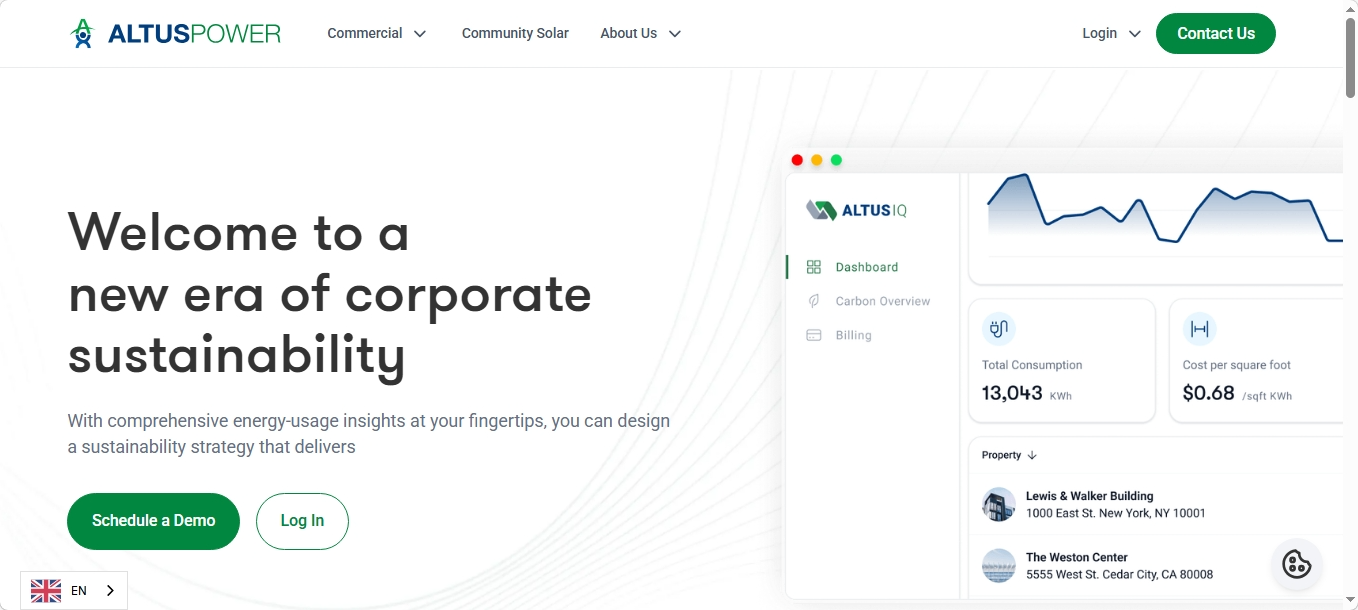
Altus IQ combines real-time monitoring with portfolio-level analytics. It integrates operational energy data with modeled emissions and financial metrics, allowing users to evaluate both environmental and economic outcomes of energy decisions across multiple assets. Some of its main features are:
Real-Time Energy Monitoring: Tracks electricity, gas, and other energy data across properties using sensor-based inputs and live updates.
Portfolio-Level Carbon Accounting: Aggregates emissions data across sites to provide a consolidated view aligned with Scope 1 and 2 tracking.
Solar Performance Visibility: Displays generation data and evaluates the impact of solar assets on energy use and carbon reduction.
Emissions & Consumption Estimation: Uses machine learning and industry datasets to model consumption patterns and forecast emissions.
Reporting & KPI Tracking: Provides dashboards and reports to measure sustainability performance and track progress against targets such as Paris alignment.
Tenant–Owner Collaboration Tools: Enables data sharing and coordination between stakeholders managing shared assets.
Closing Insights
Altus IQ was introduced by Altus Power in 2023 as part of its broader strategy to extend beyond renewable energy generation into data-driven energy management. The platform reflects the company’s focus on commercial-scale solar portfolios, where users must understand not only how much energy is generated but how it interacts with consumption patterns across multiple sites.
The dashboard has been deployed among Altus Power’s enterprise and public-sector customers, including organizations managing large real estate portfolios and community solar participation. These users rely on the platform to address different carbon accounting needs: some focus on measuring Scope 2 reductions from solar procurement, while others use it to track energy efficiency and cost impacts across assets.
A distinguishing aspect is its integration of energy data with financial and operational metrics, enabling users to evaluate decarbonization actions such as adding solar, storage, or renewable energy certificates within the same system. This makes the platform relevant in markets where energy procurement, carbon reporting, and cost management are increasingly interconnected, particularly in North America’s commercial real estate and infrastructure sectors.